United States
 Australia
 United Kingdom
 Europe
 New Zealand
 Canada


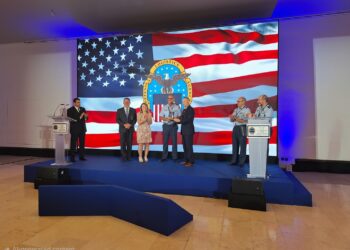
The Department of the Air Force’s Spark Tank program has selected its final Top 5 innovations from a pool of 350 submissions, closing out the competition’s last year after a multi-tier review that included subject-matter evaluations by 1,394 personnel who cast nearly 26,000 votes, command leadership input, and a final panel of innovation experts.
This year’s Top 5 span artificial intelligence, counter-drone defense, expeditionary robotics, cybersecurity compliance, and agile command-and-control:
– Automated Master Storage Plan (Air Combat Command): an AI-driven tool to rapidly design munitions warehouse layouts, compressing planning timelines from weeks to minutes.
– M-UAS-D, MANET-enabled UAS Detector (Air Combat Command): a low-cost counter-sUAS capability intended for wide deployment, providing real-time range data to operators and response teams.
– Project CAPYBARA (Air Mobility Command): a do-it-yourself rover toolkit—tutorials and parts lists—for tailoring field-ready ground robots, aimed at replacing costly temporary duty travel and certification needs.
– Secure STIG Checker (Air Force Special Operations Command): an automated compliance tool to scan massive codebases in seconds, supplanting manual enterprise network checks.
– Tac-Hub: Agile Communications for the Modern Mission (Air Force Global Strike Command): a modular, rapidly deployable C2 suite designed for military and emergency response operations.
Spark Tank is the Department of the Air Force’s premier campaign for Guardians and Airmen to pitch solutions to senior leaders and industry partners in search of sponsorship and scale. With their selection, the Top 5 teams will move to prototype acceleration and partnership development supported by AFWERX Refinery and DAF Enterprise Innovation.
In addition to the finalists, a panel of judges identified a slate of semifinalists to transition for further backing and development. They include: Aerial Minefield (Air Combat Command), a low-cost method to blanket the airspace with obstacles to deter and disable adversary drones; Agile Cyber Training Environment: Portable Cyber Ops Center (Air Combat Command), a battery-powered, network-independent package that can be set up by one person in under a minute; Contingency Remote Optical Charging Spacecraft (Space Systems Group), a concept to re-energize dead satellites using ground-based lasers; Energy Resilience Command Platform (Air Force Reserve Command), a dashboard aggregating base utilities and mission data into a real-time resilience metric; Flight Room 3D Models (Air Education and Training Command), a standardized library of 3D-printed aids for pilot training; Project HOPLITE (Air Force Special Operations Command), a flexible air defense system integrating components from existing platforms and transportable by C-130; (ReSearch) an Advanced Search Engine for EPubs (Air Force Materiel Command), which brings advanced search, natural language processing, and analytics to the EPubs platform; SpartReg 36-2903 Pictures of Dress Right vs. Wrong (Pacific Air Forces), an interactive guide to uniform standards; Streamline 1205 Narrative Sync (Pacific Air Forces), an effort to align writing formats with EPB/ORB narrative standards; The Sheppard Blueprint: A Proven Model for CONUS MTF Pharmacy Recapture (Air Education and Training Command), a low-cost approach using text outreach and 24/7 lockers to curb prescription leakage; and Vehicle Diagnostic System (Air National Guard), which consolidates multiple tools and software licenses into a single diagnostic solution.
The selections reflect an emphasis on speed, affordability, and field utility as the program wraps up, with teams now entering a phase focused on rapid iteration and pathways to operational adoption.